


GATE DA Subject Wise Weightage 2026 - AI Topic Wise Marks Distribution
GATE DA Subject Wise Weightage 2026: IIT Guwahati will conduct the GATE 2026 exam online. IIT Guwahati will post the test pattern and curriculum for GATE Data Science and Artificial Intelligence on its official website. The GATE exam 2026 will be held for 3 hours for each paper. The exam pattern for GATE 2026 is updated on this page. Here in this article, we know about GATE DA subject wise weightage 2026. The GATE 2026 exam is going to happen on February 7, 8, 14 and 15, 2026 . Candidates studying for the GATE exam should see the GATE DA Question Papers to understand the topics that will be assessed on the exam. Understanding the Topic, GATE DA subject wise weightage is the first and most important step in preparing for the GATE exam. Let's dive into the DA weightage and get you prepared for GATE 2026 exam.

GATE DA and AI Subject Wise Weightage 2026
The introduction of the Data Science and Artificial Intelligence (DA) paper in GATE 2024 marks a significant stride in India's technological advancement. GATE has aligned itself with the nation's growing digital landscape by providing a platform for aspiring data scientists and AI engineers to showcase their expertise. This move is expected to fuel innovation and research in these critical fields:
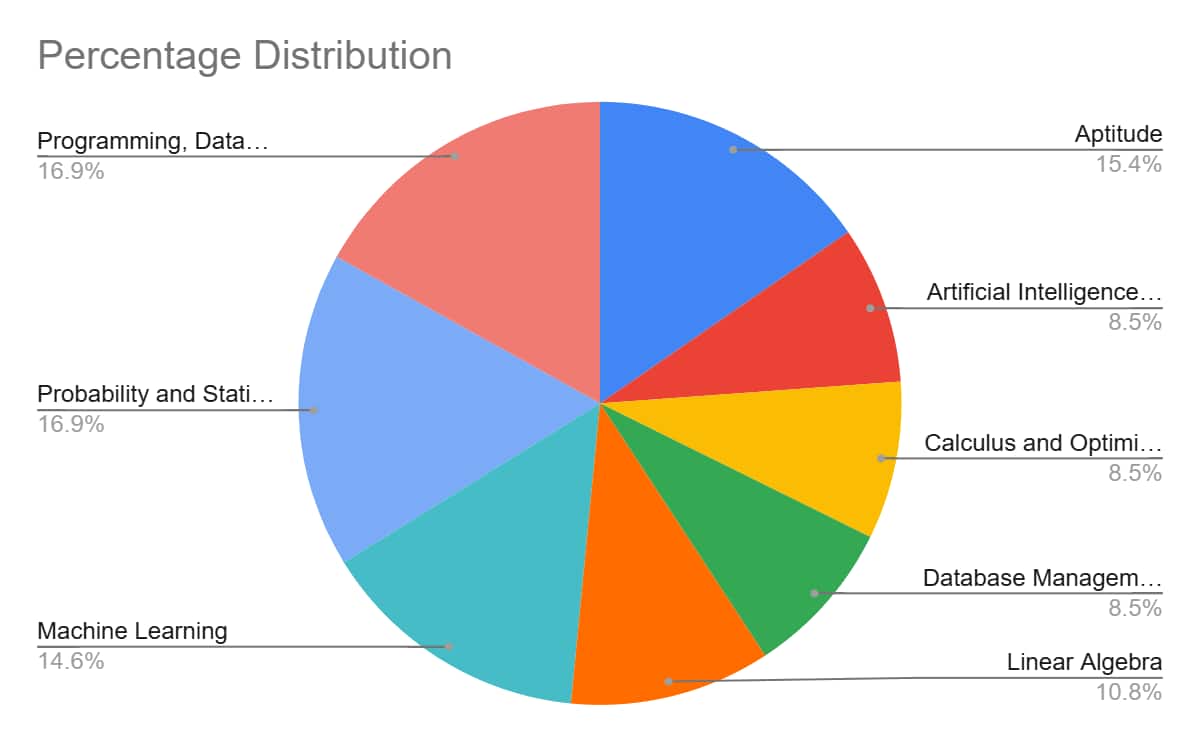
| Chapter Name | 2025 | 2024 | Total | Percentage Distribution |
| Aptitude | 10 | 10 | 20 | 15.38% |
| Artificial Intelligence (AI) | 4 | 7 | 11 | 8.46% |
| Calculus and Optimization | 6 | 5 | 11 | 8.46% |
| Database Management and Warehousing | 7 | 4 | 11 | 8.46% |
| Linear Algebra | 8 | 6 | 14 | 10.77% |
| Machine Learning | 9 | 10 | 19 | 14.62% |
| Probability and Statistics | 12 | 10 | 22 | 16.92% |
| Programming, Data Structures and Algorithms | 9 | 13 | 22 | 16.92% |
| Total | 65 | 65 | 130 | 100.00% |
A comprehensive view of the the weightage is given in the chart below to help you visualize the weightage better:
What is the Most Important Topics in GATE DA 2026?
The GATE Data Science and Artificial Intelligence (DA) test is divided into two parts: general aptitude and core data science and artificial intelligence courses. The weightage of General Aptitude and core Data Science and Artificial Intelligence is 15%. And 85% respectively. For a wrong answer chosen in an MCQ, there will be a negative marking. For a 1-mark MCQ, a 1/3 mark will be deducted for a wrong answer. For a 2-mark MCQ, a 2/3 mark will be deducted for a wrong answer. There is no negative marking for wrong answer(s) to MSQ or NAT questions. There is no partial marking in MSQ. Candidates can use GATE DA topic wise weightage pdf to prepare for GATE 2026.
| Chapter Name | Topic Name (Specific Subtopic) | Count |
| Aptitude | Dice folding and visualization | 2 |
| Geometry – cross-section visualization | 2 | |
| Graph coloring (minimum colors) | 2 | |
| Inference from passage | 2 | |
| Infinite series sum | 2 | |
| Permutations – divisibility | 1 | |
| Permutations – Divisibility rule | 1 | |
| Pie chart – percentage calculation | 2 | |
| Probability of combinations (girls/boys) | 1 | |
| Profit/Interest calculation (returns) | 2 | |
| Verbal analogy | 2 | |
| Aptitude Total | 19 | |
| Artificial Intelligence | AI – Adversarial search (alpha-beta pruning) | 1 |
| AI – Heuristic admissibility (h1, h2) | 1 | |
| AI – Search strategy (A*) and heuristic admissibility | 1 | |
| Alpha-beta pruning in adversarial search | 1 | |
| Bayesian network – conditional independence | 1 | |
| Bayesian network – joint probability computation | 1 | |
| BFS vs DFS – state expansion count | 1 | |
| BFS vs DFS – state space expansion | 1 | |
| Logic representation – rugby and round balls | 1 | |
| Neural network – weight equivalence | 1 | |
| Propositional logic – tautology identification | 1 | |
Artificial Intelligence Total | 11 | |
| Calculus and Optimization | Function continuity and differentiability (piecewise) | 1 |
| Limits and logarithmic expansion | 1 | |
| Limits and logarithmic expansions | 1 | |
| Local maxima/minima (quartic polynomial) | 1 | |
| Local maxima/minima of quartic polynomial | 1 | |
| Logistic function derivative (0.4 value) | 1 | |
| Optimization – function continuity and differentiability | 1 | |
| Optimization – local minima (2nd derivative test) | 2 | |
| Optimization – Taylor series and limits | 1 | |
Calculus and Optimization Total | 10 | |
| Database Management and Warehousing | ER model – relational schema (DB constraints) | 1 |
| Functional dependencies (DB) | 1 | |
| Functional dependencies (derivable attributes) | 1 | |
| Normalization & z-score | 1 | |
| Relational algebra – ensuring team members in defender/forward | 1 | |
| Relational algebra – set operations (Team/Defender) | 1 | |
| SQL – Index optimization (hash vs B+) | 1 | |
| SQL indexing optimization (hash vs B+) | 1 | |
| SQL query result count (joins with conditions) | 1 | |
Database Management and Warehousing Total | 9 | |
| Linear Algebra | Determinant of M2+12MM^2+12M | 1 |
| Eigenvalues and matrix properties | 1 | |
| Eigenvalues and signs of matrix | 1 | |
| Eigenvalues of matrices | 1 | |
| Eigenvalues, determinant and matrix property | 1 | |
| Matrix rank and nullity (subspaces) | 1 | |
| Matrix solution scenarios (unique/infinite/none) | 1 | |
| Matrix solutions (unique/infinite/no solutions) | 1 | |
| Projection matrix properties | 2 | |
| Python recursion & tree traversal | 1 | |
| Singular values and sum | 1 | |
| Singular values and their sum (SVD) | 1 | |
| Subspaces of R3R^3 | 1 | |
| Subspaces of R3R^3R3 | 1 | |
| Vector subspace properties | 1 | |
| Linear Algebra Total | 16 | |
| Machine Learning | Clustering – single linkage algorithm | 2 |
| Decision tree – Information gain (entropy) | 2 | |
| Fisher Linear Discriminant (between/within scatter matrices) | 1 | |
| k-means clustering – point assignment | 1 | |
| k-means clustering properties | 2 | |
| k-NN classifier (minimum k for classification) | 1 | |
| ML – Linear separability (2D datasets) | 1 | |
| ML – Linear separability of datasets | 3 | |
| Naive Bayes – number of parameters estimation | 1 | |
| Neural network – weight equivalence (ReLU) | 1 | |
| PCA, Naive Bayes, Logistic regression (classification of models) | 1 | |
| SVM – support vectors | 1 | |
Machine Learning Total | 17 | |
| Probability and Statistics | Binary search recurrence relation | 1 |
| Covariance between random variables | 1 | |
| Dynamic programming (prefix computation) | 1 | |
| Expected throws until two consecutive even outcomes | 1 | |
| Logic – Propositional representation (balls/rugby) | 1 | |
| Poisson distribution & Normal distribution properties | 2 | |
| Probability – Bayes theorem | 2 | |
| Probability – conditional expectation and variance | 1 | |
| Probability – conditional/joint events | 3 | |
| Probability – event intersection (T ∩ S) | 1 | |
| Probability – expected value (die throws) | 1 | |
| Probability – exponential distribution parameter | 2 | |
| Probability – joint PDF and expectation | 2 | |
| Probability – uniform distribution (X,Y) | 1 | |
| Probability – uniform distributions | 1 | |
| Probability – z-score normalization | 1 | |
| Probability of combinations (girls/boys) | 1 | |
| Python list reverse (recursion) | 1 | |
| Sample mean update with new data | 1 | |
| Sorting algorithms – bubble/insertion/selection passes | 1 | |
Probability and Statistics Total | 26 | |
| Programming, Data Structures and Algorithms | AI – Heuristic admissibility (h1, h2) | 1 |
| Array prefix computation (dynamic programming) | 1 | |
| Bayesian network joint probability | 1 | |
| Binary search comparisons recurrence | 1 | |
| Binary search complexity analysis | 1 | |
| Binary tree node relationships (height, leaves) | 1 | |
| Binary tree properties (height, nodes) | 1 | |
| Covariance between random variables | 1 | |
| DFS edge classification (tree/cross/back) | 2 | |
| Double-ended queue operations (insert/remove) | 1 | |
| k-NN classifier (minimum k for classification) | 1 | |
| Python list reverse using recursion | 1 | |
| Python recursion – counting tree nodes | 1 | |
| Quicksort – swaps count | 1 | |
| Relational algebra – SQL tuple verification | 1 | |
| Sorting algorithms – bubble/insertion/selection passes | 1 | |
| Stack vs queue vs hash table (matching) | 1 | |
| Topological sort of DAG | 1 | |
| Topological sorting in DAG | 1 | |
| Tree traversal combinations (preorder/inorder/postorder) | 1 | |
| Uniform hashing – expected probes | 1 | |
Programming, Data Structures and Algorithms Total | 22 | |
| Grand Total | 130 |
Benefits of GATE DA exam:
A GATE DA qualification opens doors to a wide range of exciting career opportunities:
Higher Studies: M.Tech/M.S. in Data Science or related fields: Gain specialized knowledge and skills.
Ph.D. programs: Pursue research and contribute to the advancement of data science and AI.
Public Sector Undertakings (PSUs): Work on data-driven projects and contribute to policy-making.
Enjoy competitive salaries and job security.
Private Sector: Data Scientist: Extract valuable insights from data to drive business decisions.
Machine Learning Engineer: Develop and implement machine learning models.
AI Researcher: Conduct research to push the boundaries of AI technology.
IT Consultant: Provide data-driven solutions to organizations.
Frequently Asked Questions (FAQs)
Based on recent paper trends, Probability and Statistics, Programming, Data Structures and Algorithms, Machine Learning, and General Aptitude are among the important sections in the GATE DA paper. However, candidates should prepare according to the complete syllabus and not rely only on weightage.
The GATE DA subject-wise weightage 2027 shows the approximate number of questions asked from each subject in the Data Science and Artificial Intelligence paper. It helps students understand which sections have higher weightage and need more focus during preparation.
The type of questions asked in GATE DA are
(a) Multiple Choice Questions (MCQ)
(b) Multiple Select Questions (MSQ) and/or
(c) Numerical Answer Type (NAT) Questions
Candidates can use the GATE DA weightage to identify important subjects, plan study time, and decide which topics should be covered first. It should be used along with the official syllabus, exam pattern, and previous year question papers.
Some of the important topics for GATE DA 2027 include Programming in Python, Logic, Permutation and Combination, Eigenvalues and Eigenvectors, SQL, Indexing, Ridge Regression, Clustering Algorithms, and Search. Candidates should also check previous year papers to understand topic-wise trends.
Yes, previous years’ GATE DA question papers are useful for understanding subject-wise weightage, important topics, and the type of questions asked in the exam. They also help candidates identify repeated concepts from the syllabus.
Popular Courses and Specializations
List of colleges accepting GATE

Browse Engineering Colleges by State
Questions related to GATE
On Question asked by student community
Hello Student, if you are planning to appear for GATE 2027, the registration is scheduled to start on 27 August 2026. The regular last date is 27 September 2026, and you can submit the form with a late fee up to 5 October 2026. The exam will be held on
Dear Student,
Careers360 has GATE Electrical Engineering (EE) preparation resources that can be useful for GATE 2027. While a dedicated GATE EE 2027 notes PDF may not be available, you can refer to the latest GATE EE preparation material, syllabus, important topics, books, and previous-year questions.
Hello, for GATE preparation, the best paper for a Robotics and Automation student depends on your academic background and the area you want to specialise in. Common choices include Mechanical Engineering (ME), Electronics and Communication Engineering (EC), and Electrical Engineering (EE).
You can check the GATE paper details and syllabus
Hey there,
Recommended GATE books
- Computer Science & Information Technology – GATE Previous Years' Solved Papers — use it chapter-wise after completing each C topic.
- Made Easy – GATE Computer Science & IT — useful for structured theory and practice.
- Arihant GATE Computer Science & Information Technology — useful for
For GATE preparation, you should first follow the official GATE syllabus and then choose textbooks according to your engineering branch.
For each subject, a good preparation strategy is:
Study the basic concepts from a standard textbook.
Make short notes and formula sheets.
Solve topic-wise GATE previous-year questions.
Practise numerical-answer-type questions